China Top 10 Marine Grade LCD Monitor Manufacturers
Reliable displays help crews read navigation data, alarms, and camera feeds in glare, spray, and vibration. UNCTAD’s Review of Maritime Transport 2024 reports that more than 80% of world trade by volume moves by sea. That scale makes dependable onboard equipment operationally important, though it does not measure LCD monitor demand directly.
Marine scientist Sylvia Earle’s words offer a reminder of the environment these systems serve: “No water, no life. No blue, no green.” Her quote is not a display specification. For Marine-Grade Lcd Monitors, buyers should compare sunlight readability, optical bonding, touch performance, viewing angles, temperature range, vibration tolerance, and available video interfaces. IEC 60945 sets environmental and electromagnetic-compatibility test methods for marine navigation and radio equipment; checking a product’s stated test evidence is more useful than relying on a rugged-looking enclosure alone.
This China Top 10 Marine Grade LCD Monitor Manufacturers overview should help readers compare suppliers by documented capabilities, product range, and support—not by rank alone. A bright screen can still wash out at a poor viewing angle. A sealed front panel does not prove the whole unit suits every vessel. There is no perfect shortlist. Specifications may be incomplete, and published claims deserve verification against datasheets, certificates, and installation conditions. Ask for the exact model’s test documentation and confirm that its connectors, brightness, and mounting fit the bridge or control station. The best choice is the one tested for the actual installation, not merely the one with the longest feature list.
Marine-Grade LCD Monitors: Definition, Applications, and Product Categories
Marine-grade LCD monitors are displays built for vessel environments, where salt spray, vibration, humidity, and changing temperatures can shorten equipment life. Typical design features include sealed front bezels, corrosion-resistant fasteners, reinforced housings, and touchscreens usable with wet hands or gloves. Some models add optical bonding to improve readability and reduce internal reflections. Salt is relentless.
“Marine grade” is not one universal specification. Buyers should check enclosure ratings, brightness, operating temperature, vibration tolerance, and installation requirements against the vessel’s actual conditions. A monitor suited to a protected cabin may not perform well on an exposed bridge wing. That distinction is easy to overlook.
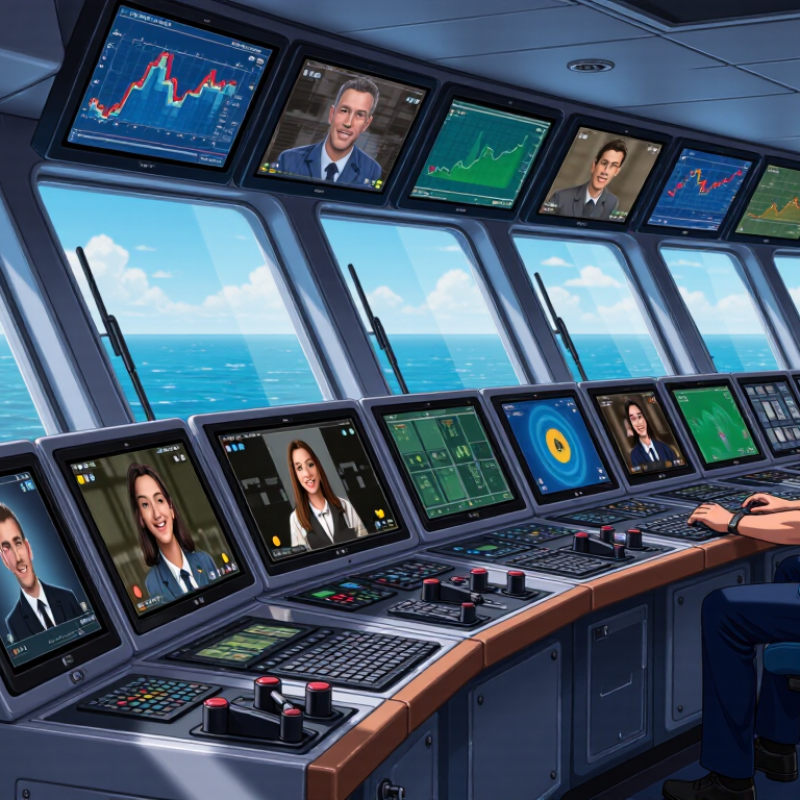
Applications include navigation and radar stations on the bridge, engine monitoring consoles, machinery spaces, and passenger information systems. Product categories range from sunlight-readable displays and panel-mount monitors to open-frame units for custom consoles and rugged touchscreen models. High brightness helps in daylight, while adjustable dimming matters during night operation. A brighter screen can also generate more heat and use more power, so maximum brightness is not always the best setting. The right choice depends on placement, viewing distance, available space, and the signals the display must accept. Even careful specifications cannot replace checking the finished installation in real operating conditions.
IEC 60945 and IEC 60529: Marine Equipment and IP66 Protection
A marine LCD monitor must handle more than a clear image. On a bridge, spray, vibration, temperature changes, and electrical interference can affect dependable operation. IEC 60945 addresses environmental, electromagnetic compatibility, and safety requirements for applicable maritime navigation and radiocommunication equipment. Check whether the monitor’s intended use and certification scope match the vessel installation. A standard number alone is not proof of suitability.
IEC 60529 defines IP enclosure ratings. IP66 means the enclosure is dust-tight and protected against powerful water jets under specified test conditions. Not immersion protection. It also does not, by itself, establish resistance to salt corrosion, sunlight, or long-term vibration. Those are separate considerations, and overlooking them is an easy mistake.
Inspect the complete installation, not just the display housing. Check connector seals, cable glands, panel cut-outs, and the way cables enter the enclosure. A poorly sealed connector can undermine an otherwise well-rated monitor. Ask for test documentation and confirm the rating applies to the assembled unit, including its supplied accessories. In practice, maintenance access matters too; a tight installation can make seal inspection awkward. Specifications help, but the details deserve a closer look.
Display Benchmarks: 1,000 cd/m² Brightness and Daylight Readability
A 1,000 cd/m² marine display is a practical brightness benchmark, not a guarantee of clear viewing. The NREL-hosted ASTM G173 reference solar spectrum reports roughly 1,000 W/m² of global tilted irradiance under standard test conditions. Irradiance and screen luminance are different measurements, but the figure illustrates the intense light a display may face. Reflections from glass can still wash out charts, even when the backlight is powerful.
Daylight readability depends on contrast, surface treatment, viewing angle, and thermal control. A bright panel can become harder to read when sunlight reflects off a wet, glossy cover. IEC 60945 offers environmental and testing guidance for shipborne navigation and radio equipment; it does not set a universal 1,000 cd/m² requirement. Ask manufacturers for measured luminance after warm-up, contrast data, and results under strong ambient light. I would not rely on peak brightness alone. It is an easy number to advertise.
Tips: Check the screen from the helm at noon, then from an off-center seat. Test with polarized sunglasses, too. Note glare, washed-out text, and brightness reduction as the unit heats. Small details matter. A real outdoor trial can expose limits that a specification sheet misses.
China’s Top 10 Marine-Grade LCD Monitor Manufacturers and Product Profiles
China’s top ten marine-grade LCD monitor manufacturers should be compared by operating conditions, not screen size alone. UNCTAD’s Review of Maritime Transport 2024 reports that over 80% of global merchandise trade by volume travels by sea. Shipboard displays therefore need dependable performance through vibration, salt-laden air, and changing cabin temperatures. Small details matter. A dim screen can become hard to read when sunlight hits the bridge console.
Useful product profiles should specify brightness, viewing angle, input options, power range, and mounting method. For example, a 1,000-nit panel may suit a bright wheelhouse, while optical bonding can reduce reflections. These are comparison points, not guarantees; buyers should check tested configurations. IEC 60945 provides relevant environmental and electromagnetic compatibility requirements for maritime navigation and radio equipment. Profiles should state whether products are designed or tested against applicable requirements, rather than relying on vague “marine-grade” claims.
A practical ten-manufacturer review can distinguish rugged bridge displays, compact engine-room monitors, and larger chart or control-room screens. Compare glove-compatible touch controls, sealed front panels, service access, and documented temperature limits. Ask for the exact test conditions and warranty coverage. No screen is perfect. Installation, glare, and calibration still affect performance, and published specifications do not always reflect years of salt spray and vibration.
Typical Marine-Grade LCD Monitor Screen-Size Bands
The bands show approximate screen sizes commonly found in marine and industrial display catalogs. They are illustrative, not a manufacturer ranking or a count of available products; check individual product datasheets for exact specifications.
Supplier Evaluation: Certification, Service Life, and After-Sales Support
A marine-grade LCD monitor should be evaluated through verifiable test records, not a “marine” label alone. IEC 60945 covers environmental, vibration, and electromagnetic-compatibility testing for navigational and radiocommunication equipment. Ask suppliers for the certificate scope, tested model, test conditions, and issuing laboratory. Check that the offered unit matches the tested configuration. Small differences matter. A certificate for a product family may not cover every screen size or connector option. Allianz Commercial’s Safety and Shipping Review 2024 recorded 26 total losses of vessels over 100 gross tons in 2023. This is not a monitor-failure statistic, but it underscores the demanding environment onboard.
For service life, request rated operating hours, backlight replacement details, and the temperature range behind any lifetime claim. Compare like with like; MTBF is not a promised service life. Ask how quickly spare panels, power supplies, and sealed cables can be shipped, and whether repairs are possible near your operating ports. Get warranty duration, response times, and exclusions in writing. Test the after-sales process before purchase with a specific technical question. Notice how clearly the supplier answers. I would also ask for a sample service report; many evaluations overlook repair turnaround, and that is an easy mistake to make.

 +86-13662287276