
 +86-13662287276


News


How Curved Displays Became the New Darling of Commercial Display Industry
2025-05-07
Only through comparison can we determine superiority. To unravel why curved displays have become the industry's favorite, let's first analyze the comparison table below and trace the evolutionary history of display technology—the answer will then become evident.
Display performance parameter comparison table
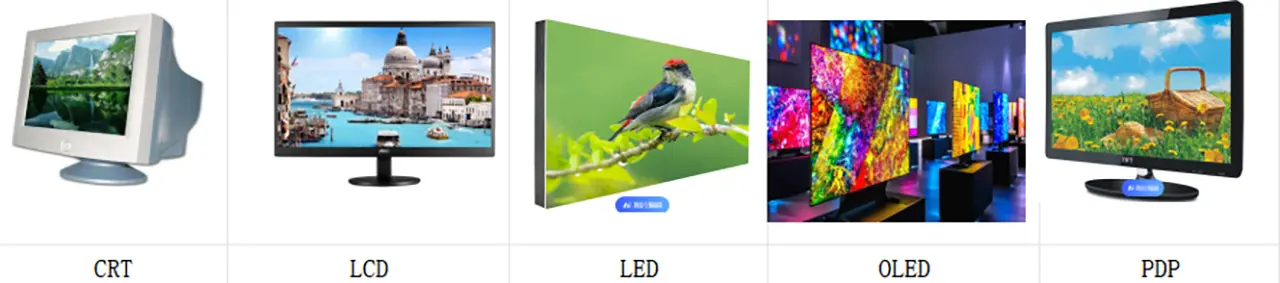
Display type Performance Parameter | CRT/Cathode Ray Tube | LCD/Backlit Liquid Crystal | LED/Light-Emitting Diode | OLED | PDP/Plasma Display |
Color/Image Quality | Unlimited colors, excellent color quality, ideal for professional graphics/High resolution, low motion blur, perfect for fast-moving images. | Low resolution contrast ratio/Small viewing Angle | Improved color and brightness over LCD | High contrast, true-to-life colors, delicate | Excellent color/Image clarity |
Size/Weight | Bulky/Heavy | Compact/Lightweight | Thin/Light | Thinnest/flexible | Bulky/heavy |
Energy consumption/Environmental protection | High power consumption/Radiation | Low Power Consumption/Eco-friendly | High heat/no radiation | Low power consumption/Eco-friendly | High energy consumption, high heat / Low radiation, environmental protection |
Lifespan/Maintenance | Short lifespan/Difficult maintenance | Long lifespan/Easy maintenance | Long lifespan | Short lifespan/difficult maintenance (burn-in, flickering issues) | Short lifespan/Difficult maintenance |
Response Speed | Fast | Fast | Slower than LCD | Fast | Slow |
Cost | High | Affordable | Higher than LCD | High | High |
Display Images of Various Screen Types:
Historical Context
The evolution of display technology—from CRT to LCD and plasma, with transitional rear-projection systems—has driven advancements in television displays. Progressing from backlighting to LCD, 3D, UHD, and OLED, the industry reached a milestone in 2014 with the introduction of curved UHD LCD TVs, marking a definitive technological trend.
Ergonomic Superiority
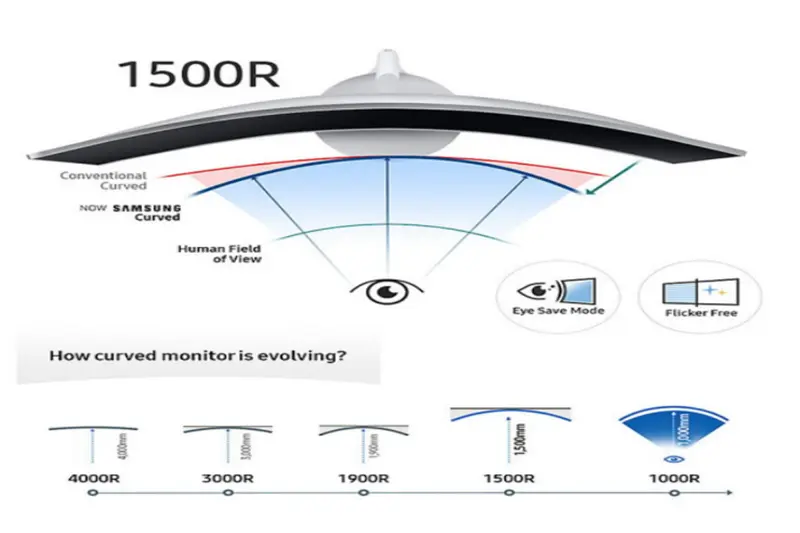
The spherical shape of human eyes makes flat screens inherently distort visual perception, especially noticeable on larger displays. Curved screens, however, align with ergonomic principles, delivering a more natural viewing experience. Users gain a cinematic immersion, with wider optimal viewing angles at the edges, enhanced comfort, and unparalleled presence. Their sleek arc design also aligns with modern aesthetics—much like streamlined cars or rounded smartphones.
In 2014, curved LCD panels became the first to pass performance certification by China’s CESI (Electronic Industrial Standardization Institute), a landmark achievement for the industry.
Market Trends
Currently, LCD and OLED dominate curved display substrates:
• LCD-based curved displays: Ranging from 23.8 to 55 inches.
• OLED curved displays: Optimized for larger screens.
Curved displays adopt human-optimized curvature, ensuring equidistant visibility from the viewer’s eyes to every screen point, thus offering broader fields of view and deeper immersion. While higher curvature increases manufacturing complexity, user tests confirm that screen size, not just curvature, dictates visual excellence.
With refined manufacturing and technological breakthroughs, curved displays have achieved remarkable improvements in contrast and brightness uniformity, solidifying their status as the commercial display industry’s rising star!