
 +86-13662287276


News


A Fusion of Cultural Artistry and Technological Innovation - The Transparent Display Cabinet
2025-05-07
Traditional exhibition methods for luxury goods, priceless artworks, cultural relics, and high-tech products face multiple limitations:
1. Time and space constraints;
2. High construction/maintenance costs;
3. Limited content presentation formats;
4. Poor interactivity and safety/environmental concerns.
With rapid technological advancements, transparent screens have emerged as a revolutionary display medium. This groundbreaking technology not only redefines visual presentation but also delivers unprecedented immersive experiences and creative applications, seamlessly blending the virtual and physical worlds.

Cultural & Artistic Exhibition

Luxury Exhibition
Unparalleled Visual Impact
Transparent screens achieve high transparency through specialized materials and manufacturing processes. Unlike conventional displays, they function as "invisible windows," allowing clear visibility of background objects while projecting vibrant content. This creates an expansive, open spatial perception that captivates viewers.Immersive Interactive Experiences
The transparent screen delivers an unparalleled immersive experience, unlocking boundless creativity for users. With its ability to project ultra-realistic images and videos, it seamlessly merges the virtual and physical worlds.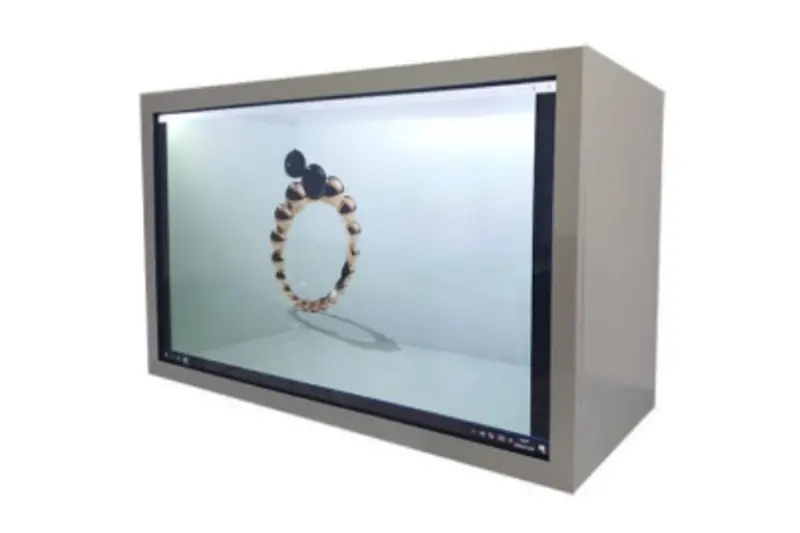

Transparent display technology primarily includes LCD transparent screens, LED transparent screens, OLED transparent screens, and others.
The LCD transparent screen features a backlight layer at its base, which illuminates the various stacked layers above. This design inherently demonstrates that most layers of traditional LCD screens are fundamentally transparent to some degree.
LED transparent screens, as the name suggests, are LED displays engineered to achieve transparency. By optimizing the structure to reduce obstruction from light panels and components, these screens allow viewers to see through them at certain angles. This creates a three-dimensional effect for displayed content, making images appear to float in mid-air while maintaining visibility of objects behind the screen.
OLED transparent screens represent self-emissive organic OLED displays manufactured with transparent technology, reminiscent of the futuristic screens seen in science fiction films. These screens offer dual-sided visibility, where non-illuminated pixels maintain high transparency, enabling augmented reality overlays.
In commercial applications, LCD transparent screens have gained widespread adoption. Retail storefronts utilize them to showcase product information prominently while capturing customer attention. At exhibitions, they overcome traditional display limitations by delivering vivid, three-dimensional presentations. Their slim and lightweight design also simplifies transportation and installation, significantly reducing labor and resource requirements.
Fundamentally, LCD transparent screens exemplify the perfect marriage of fashion and technology through advanced engineering. They not only enhance presentation quality and user experience but also demonstrate tremendous potential across commercial applications. As technology continues to advance, LCD transparent screens will undoubtedly find broader implementation, bringing more convenient and intelligent experiences to daily life.
ISEE DISPLAY manufactures horizontal LCD transparent screens for innovative product displays and vertical LCD digital human display cabinets featuring AI-powered holographic interfaces. These cutting-edge solutions enable virtual reality digital twins and natural language interaction, facilitating face-to-face communication with digital humans. The systems support multimodal interaction, including business processing, consultation services, information broadcasting, service guidance, and real-time engagement through holographic displays.
What was once confined to science fiction has now become reality—transparent screens are gradually integrating into our everyday lives. As display technology evolves, these innovative screens are emerging as a groundbreaking visual medium, delivering unprecedented viewing experiences.
The primary advantage of transparent screens lies in their transparency. Unlike conventional displays, they resemble ordinary glass, permitting clear visibility of background objects. This unique characteristic makes them invaluable in various settings. Museums and galleries employ them to exhibit artifacts and artworks without obstructing other displays, while commercial spaces use them for advertising that remains visible alongside background scenery.
Beyond transparency, these screens offer additional features. Touch interactivity enables intuitive operation, while special effects like 3D and holographic displays create stunning visual impact. However, as an emerging technology, transparent screens still face challenges. Current production yields remain relatively low, resulting in higher manufacturing costs that limit widespread adoption. Their operational lifespan also requires improvement, as issues like aging and damage necessitate ongoing technical refinement and quality control. Privacy protection presents another consideration, demanding both technological and administrative safeguards.
In summary, transparent display technology holds immense potential and broad application prospects. With continued technological advancements and expanding use cases, transparent screens are poised to redefine the future of display technology, offering increasingly sophisticated visual experiences.
The main types of transparent displays include OLED, LED, and LCD screens. OLED transparent screens represent self-emissive organic displays manufactured with transparent processes, achieving the futuristic transparent screen effect seen in films. They offer dual-sided visibility, with non-active pixels maintaining high transparency to enable augmented reality overlays. Currently the most mature technology for transparent TVs, OLED transparent screens require transparent substrates and electrodes. When inactive, they achieve over 85% light transmittance, while displaying content visible from both sides. The technology's key lies in its transparent electrodes and organic thin films, which combine low resistance with high transparency. Since each RGB sub-pixel emits its own light without requiring a backlight, OLED delivers superior transparent display performance.
LED transparent screens are essentially conventional LED displays engineered for transparency. Through optimized chip manufacturing, LED packaging, and control systems, they reduce visual obstruction from components, creating a see-through effect at certain viewing angles. This allows background visibility while displaying content that appears three-dimensional and floating. The structural design significantly improves transparency. As inorganic transparent displays, their primary components (SMD LEDs) control light emission to show text, images, animations, and videos. By replacing unnecessary backgrounds with black in content design, the non-illuminated black areas maintain transparency during playback.
LCD transparent screens retain the backlight layer of traditional LCDs, which illuminates the upper layers—demonstrating that most LCD layers are inherently transparent. By removing the backlight unit (including light guides) and utilizing ambient or alternative light sources, these screens achieve semi-transparency. Essentially incomplete LCD panels, they position displayed objects between the light source and display layers. Requiring external enclosures as light sources, LCD transparent screens cannot function normally otherwise. Unlike self-emissive technologies, they depend on supplemental lighting and appear black when unpowered.
The transparent screen market is growing rapidly, and it is expected that the market size will significantly expand in the future, with an average annual growth rate of up to 46%. In terms of application scope in China, the size of the commercial display market has exceeded 180 billion yuan, and the development of the transparent display market is very rapid. Moreover, OLED transparent screens are widely used in various scenarios such as digital signage, commercial displays, transportation, construction, and home furnishings due to their high transparency and lightweight characteristics.
OLED transparent screens combine the real world with virtual information to create new visual experiences and application scenarios.
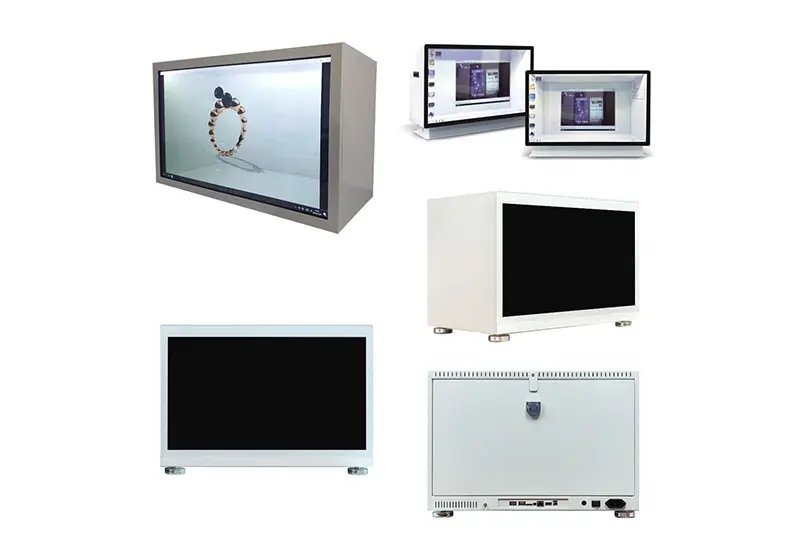
OLED transparent screens have the following advantages: High transparency: Using a transparent substrate, light can pass through the screen, and the background and image blend together, providing a realistic visual experience; Vibrant Colors: OLED materials can directly emit light without the need for a backlight source, resulting in more natural and vibrant colors; Low energy consumption: OLED transparent screens support local brightness adjustment and consume less energy than traditional LCD displays; Wide viewing angle: Excellent all-round display effect, no matter from which angle it is viewed, the display effect is very good.
Our OLED touch screen transparent display cabinet available size is 12 inch to 86 inch, it can support with outline cabinet or not, and our standard support HDMI+DVI+VGA video input interface. What’s more, regarding video playback, we can also choose a card player and an Android player as optional options, can flexibly ensure the effectiveness and compatibility of video display and playback. Standard is IR touch technology, but we also can support PCAP touch technology, support Android 11 OS, and windows 7 OS and Windows 10 OS, the i3/i5/i7 processor is available. 4G ROM, 128GB SSD, solid state drive 120G can be support.
OLED Touchscreen Transparent Displays
The transparent display market is experiencing rapid growth, with projections indicating significant expansion in the coming years at an impressive annual growth rate of 46%. In China, the commercial display market has already surpassed 180 billion yuan, with transparent displays developing at an accelerated pace. Thanks to their high transparency and lightweight design, OLED transparent screens are now widely adopted across various sectors, including digital signage, commercial displays, transportation, architecture, and home applications.
OLED transparent screens seamlessly merge the physical world with digital information, creating innovative visual experiences and opening up new application possibilities.
Key Advantages of OLED Transparent Screens:
High Transparency: Utilizing transparent substrates, these screens allow light to pass through, blending background elements with displayed images for a remarkably lifelike visual experience.
Vibrant Colors: With self-emissive OLED materials that require no backlight, the screens produce richer, more natural colors.
Energy Efficiency: OLED transparent screens feature localized brightness adjustment, consuming less power than traditional LCD displays.
Wide Viewing Angles: They deliver exceptional display quality from all perspectives, ensuring consistent visual performance regardless of the viewing angle.